Play better
Word game strategy: how to score more
Most games are won by a handful of good habits, not by knowing the longest words. These tips work in Racketile and in most crossword-tile games. Keep the letter tile values open in another tab while you read.
1. Keep a balanced rack
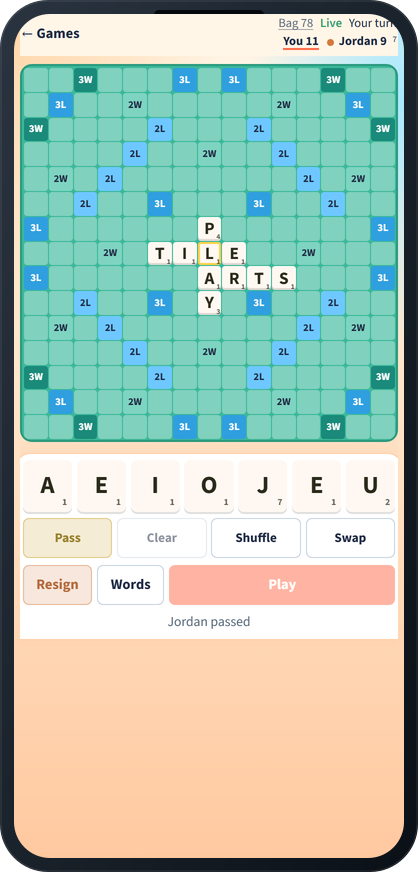
After each turn you draw back up to 7 tiles. What you keep matters as much as what you play. A rack with a mix of vowels and consonants gives you options next turn. Three or more of the same vowel, or no vowels at all, usually means a weak turn ahead.
- Play off duplicate letters when you can.
- Hold common, flexible letters like E, R, S, and T.
- Swap tiles when the rack is hopeless. Losing one turn's score is often cheaper than two bad turns in a row.
2. Use the premium squares
A word on a 3W square is worth three times as much, and a high-value letter on a 3L square can score more than a long word in the open. Look for spots where a short word reaches a premium square, and where one letter lands on a letter square while the word covers a word square.
3. Score in two directions
Placing a word alongside another one forms several short words at once, and every one of them scores. Two-letter words are the key to these plays. Learning them is the fastest way to raise your average score.
4. Go for all 7 tiles
Playing your whole rack in one turn adds 50 points in most modes. Keep letters that combine well and look for common endings to build toward it. A blank makes this much easier, so do not spend one on a small play.
5. Spend high-value letters well
Q, X, Z, and J are worth a lot, but only if you place them well. Put them on a letter square, or where they form words in both directions. Holding one too long can leave you stuck with it at the end.
6. Watch what you open up
Every word you play can give your opponent a lane to a premium square. Before you play, check what your word leaves next to a 3W. Sometimes a slightly smaller score that keeps the board tight is the better move.
7. Plan the end of the game
When the bag runs low, count what is left and think about going out first. The game ends when the bag is empty and a player plays their last tile, and tiles left on a rack count against that player.
Strategy by mode
- Golf: low scores win, so use small plays and avoid premium squares.
- Rush and Flag Run: playing quickly earns a speed bonus, so a good word can beat a great word later.
- Flag Run: reaching the other flag wins outright, so race toward it or block the path to yours.
- Fog: premium squares are hidden, so rack balance and two-way plays matter more.
Practice
The quickest way to improve is to play often. Play against the computer to try ideas, starting with an easy bot and working up to Apex.
Questions
What is the best strategy for a crossword-tile word game?
Keep a balanced rack, use premium squares, score in two directions with short words, and try to play all 7 tiles for the 50 point bonus.
When should I swap tiles?
When your rack has no good play and keeping it would hurt your next turn too, such as several copies of one vowel or no vowels at all.
How do I practice?
Play the practice bots. Start with Rookie and move up to harder bots as you start winning.
Prefer the browser? Log in to play